

By Frank Wang, Licensed Paralegal
Frank Wang Paralegal Services
Receiving a Small Claims Court lawsuit can be stressful and overwhelming. However, being sued does not mean the plaintiff will automatically win. By responding promptly and taking the right steps, many disputes can be resolved through negotiation, settlement, or a successful legal defence.
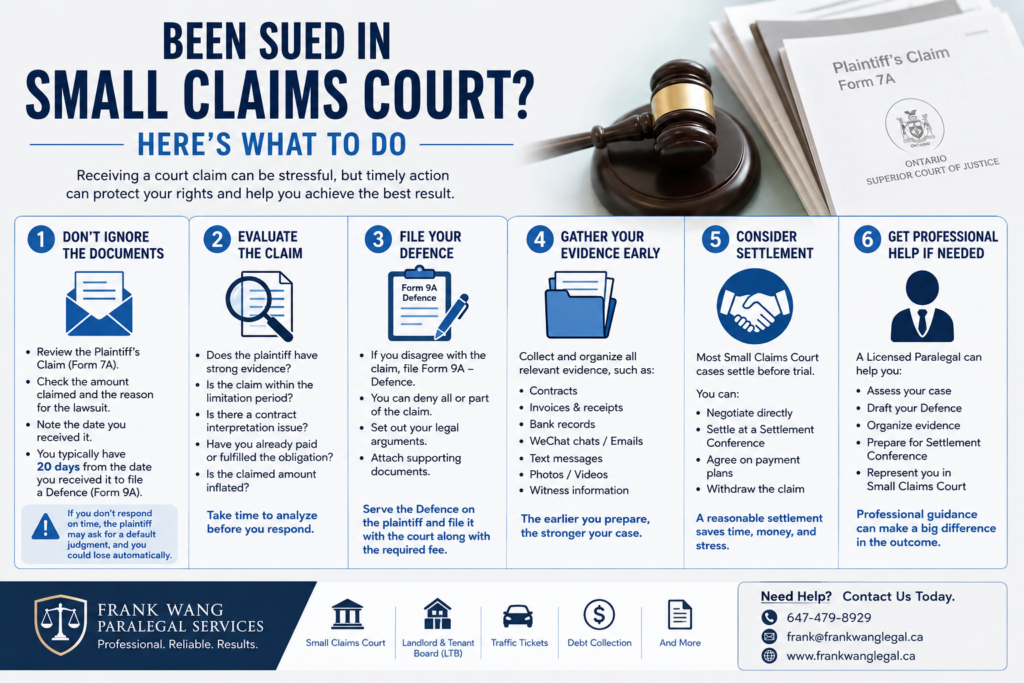
Step 1: Don’t Ignore the Court Documents
After you receive a Plaintiff’s Claim (Form 7A), carefully review the following:
- The amount being claimed;
- Why the plaintiff is suing you;
- Whether the claim includes supporting evidence such as contracts, invoices, photographs, emails, or text messages;
- The deadline for filing your response.
In Ontario, a defendant generally has 20 days after being served with the claim to file a Defence (Form 9A). If you fail to respond on time, the plaintiff may obtain a default judgment, meaning the court could decide the case without hearing your side.
Step 2: Evaluate the Claim
Before admitting or denying the allegations, carefully assess the case by asking:
- Does the plaintiff have sufficient evidence?
- Is the claim filed within the applicable limitation period?
- Is there a misunderstanding or dispute over the contract?
- Have you already paid or fulfilled your obligations?
- Is the plaintiff exaggerating the amount of damages?
Many lawsuits are not as straightforward as they initially appear.
Step 3: Prepare and File Your Defence
If you disagree with the plaintiff’s claim, you should prepare and file a Defence (Form 9A).
Your Defence may include:
- A denial of all or part of the claim;
- Admissions of certain facts where appropriate;
- Your legal arguments and explanations;
- Copies of supporting documents and evidence.
Once completed, your Defence must be served on the plaintiff and filed with the Small Claims Court, together with the required filing fee.
Step 4: Gather Your Evidence Early
The sooner you organize your evidence, the stronger your case may become.
Useful evidence may include:
- Contracts
- Invoices and receipts
- Bank records
- Emails and text messages
- WeChat conversations
- Photographs and videos
- Witness statements or contact information
Do not wait until shortly before trial to begin collecting evidence.
Step 5: Consider Settlement
Most Small Claims Court cases are resolved before trial.
Possible settlement options include:
- Direct negotiation between the parties;
- Reaching an agreement at the Settlement Conference;
- Payment arrangements or instalment plans;
- Mutual withdrawal of the claim.
A reasonable settlement can often save both time and legal costs.
Step 6: Seek Professional Legal Assistance
Although Small Claims Court procedures are designed to be more accessible, they still involve important legal rules and evidentiary requirements.
A Licensed Paralegal can assist you by:
- Evaluating the strengths and weaknesses of your case;
- Drafting your Defence;
- Organizing your evidence;
- Preparing you for the Settlement Conference;
- Representing you throughout the Small Claims Court process.
Conclusion
Receiving a lawsuit is not the end of the story—it is the beginning of the legal process.
By acting promptly, preserving evidence, understanding your legal rights, and responding appropriately, you can significantly improve your chances of achieving a favourable outcome.
Don’t ignore a lawsuit, and don’t miss important court deadlines. Taking timely action is the first step toward protecting your legal rights.